SSM-Based Data-Driven Control for Soft Robotic Muscles
Data-driven slow-manifold modeling and inverse-SSM control for antagonistic HASEL-clutch joints (arXiv:2601.03247).
Outcome
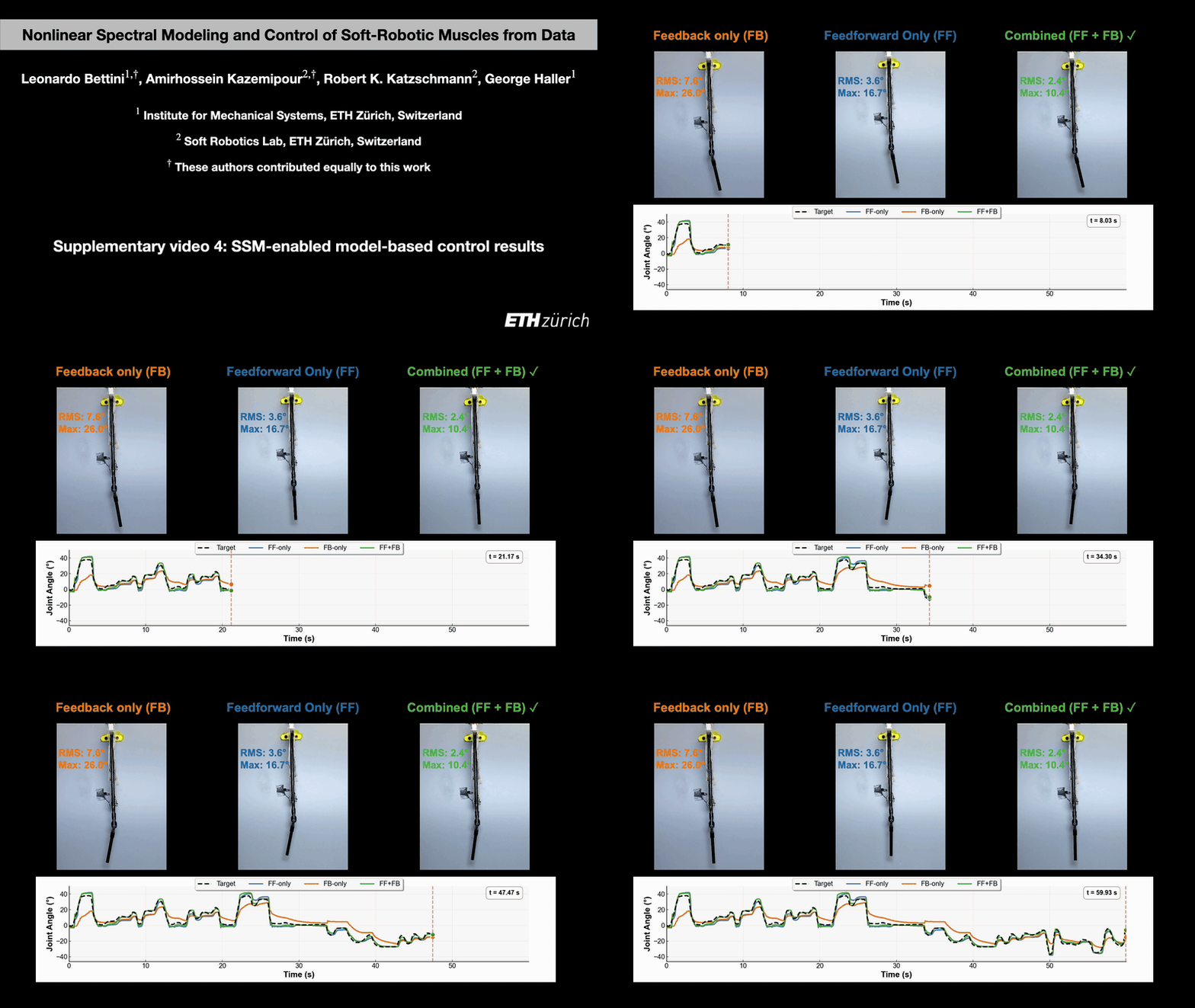
I built a data-driven slow-manifold (SSM-based) inverse-model controller for antagonistic HASEL-clutch joints and achieved substantially lower tracking error than feedback-only and feedforward-only baselines.
Problem
Electrohydraulic artificial muscles have strong nonlinearities, hysteresis, and memory effects that make high-fidelity physics modeling expensive and hard to deploy in real time. This project learned a compact reduced-order model directly from forced-response data and used it for fast closed-loop control on hardware.
System
- Hardware: antagonistic HASEL muscles with electrostatic clutches and joint-angle sensing
- Modeling: spectral-submanifold reduction in the adiabatic regime, learning a slow-manifold map from forced-response trajectories
- Control: inverse SSM feedforward plus PI feedback with anti-windup, saturation, and slew-rate limits
- Validation: randomized unseen trajectory tracking under identical safety constraints across controller baselines
Contribution
- Co-first author (equal contribution)
- Data-driven model-reduction and control-pipeline design
- Controller benchmarking design (feedforward-only, feedback-only, combined)
- Experimental validation on antagonistic muscle hardware
Technical Stack
- Nonlinear dynamics and spectral-submanifold reduction
- Data-driven reduced-order modeling from forced-response trajectories
- Inverse-model feedforward + PI feedback control
- Real-time antagonistic soft-robot control experiments
Key Results
- Combined inverse-SSM + PI controller: RMS error
2.38°, max error10.41° - Feedforward-only baseline: RMS error
3.63°, max error16.67° - Feedback-only baseline: RMS error
7.63°, max error26.00° - Relative to feedback-only, combined control reduced RMS error by ~
69%and max error by ~60% - Relative to feedforward-only, combined control reduced RMS error by ~
34%and max error by ~38%
Media


Links
- Publication: Publications page (arXiv preprint)
- Paper: arXiv preprint (arXiv:2601.03247)
- PDF: arXiv PDF
- Status: Under review at Nature Communications
Skills
nonlinear modeling data-driven control soft robotics experimental benchmarking