SSM-Based Data-Driven Control for Soft Robotic Muscles
Data-driven spectral submanifold (SSM) modeling and closed-loop control for antagonistic electrohydraulic musculoskeletal joints.
Published in Nature Communications on 16 September 2026.
Leonardo Bettini and Amirhossein Kazemipour contributed equally.
Outcome
I built and controlled an antagonistic electrohydraulic musculoskeletal joint using a data-driven spectral submanifold (SSM) model for feedforward control. The combined controller was validated on hardware and reduced tracking error substantially compared with both feedback-only and feedforward-only baselines.

Problem
Electrohydraulic artificial muscles are compliant, strongly nonlinear, and history-dependent. In practice, this makes first-principles modeling hard to scale for real-time control. The goal of this project was to keep model-based control benefits while avoiding a heavy full-order model, by learning a compact dynamical representation directly from experiment data and deploying it on real hardware.
System
- Hardware platform: antagonistic HASEL-clutch artificial-muscle joint with joint-angle sensing and high-voltage actuation
- Data collection: forced-response trajectories across the operating range used to identify reduced-order dynamics
- Modeling: SSM-based reduced model in the adiabatic regime, including a learned map between voltage input and joint motion
- Control law: inverse-SSM feedforward combined with PI feedback, anti-windup, and command-rate/safety limits
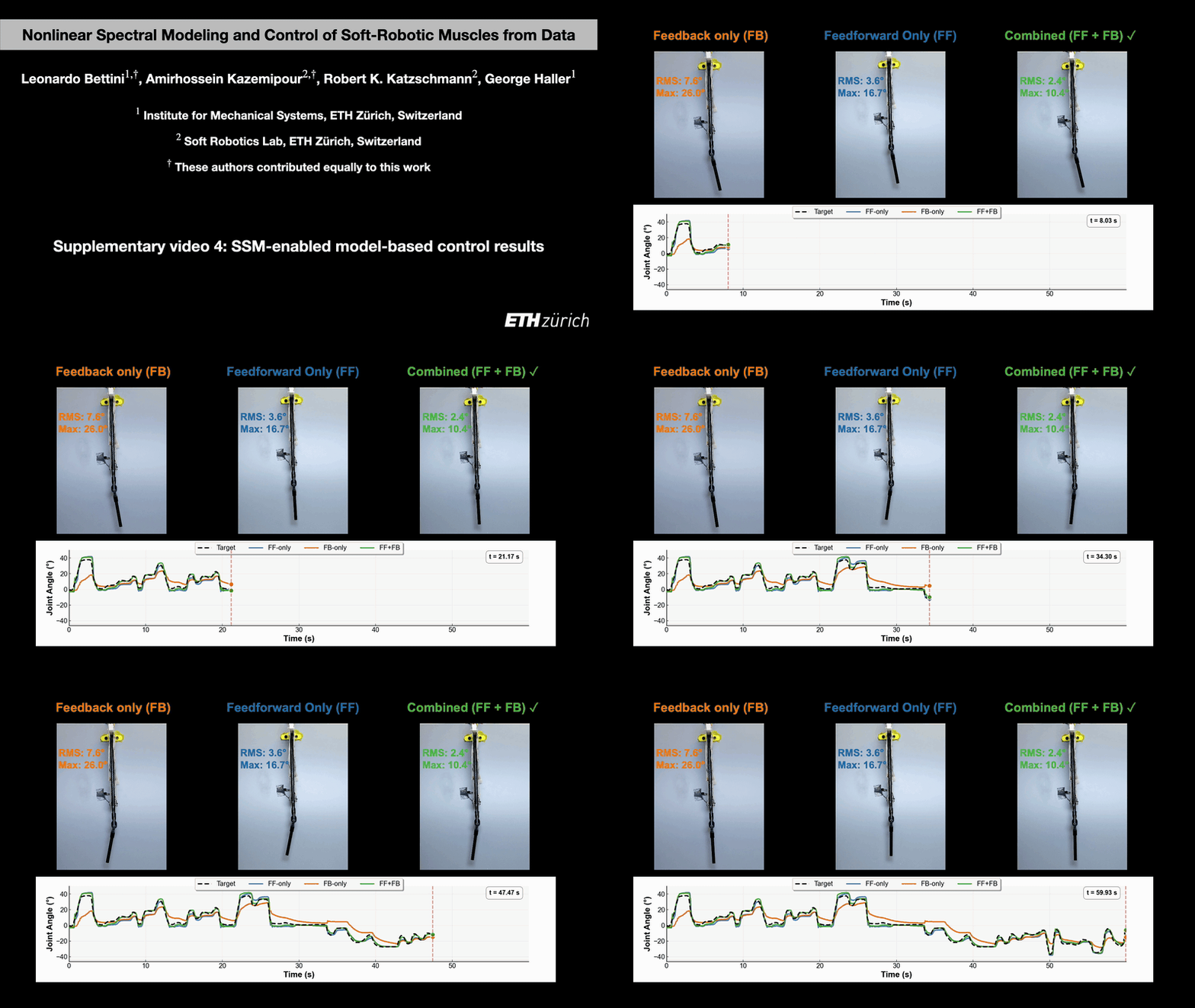
- Validation protocol: identical constraints and trajectories across three controllers (feedforward-only, feedback-only, combined)
Contribution
- Built and integrated the antagonistic electrohydraulic hardware platform used for model identification and control validation
- Implemented the real-time control stack and deployed the inverse-SSM + PI controller on physical hardware
- Designed and executed benchmark experiments for fair comparison across controller variants
- Co-developed the overall data-driven control pipeline and evaluation workflow
Technical Stack
- Electrohydraulic antagonistic-joint hardware integration
- Spectral submanifold (SSM) reduced-order modeling
- Data-driven system identification from forced-response experiments
- Inverse-model feedforward + PI feedback control
- Real-time closed-loop control and benchmarking on hardware
Key Results
- Combined inverse-SSM + PI controller: RMS error
2.38°, max error10.41° - Feedforward-only baseline: RMS error
3.63°, max error16.67° - Feedback-only baseline: RMS error
7.63°, max error26.00° - Relative to feedback-only, combined control reduced RMS error by ~
69%and max error by ~60% - Relative to feedforward-only, combined control reduced RMS error by ~
34%and max error by ~38%

Media
Impact and Future Direction
This project shows a practical path for deploying data-driven nonlinear control on musculoskeletal robotic joints: learn compact dynamics from real data, then run model-based feedforward with feedback correction in real time. The same approach can be extended to multi-joint antagonistic systems and more demanding motion tasks where pure black-box control or full-order modeling alone is limiting.
Links
- Paper: Nature Communications
- PDF: Published paper
- DOI: 10.1038/s41467-026-77664-0
- Preprint: arXiv (2601.03247)
Skills
data-driven control SSM modeling electrohydraulic muscles hardware integration real-time control benchmarking